
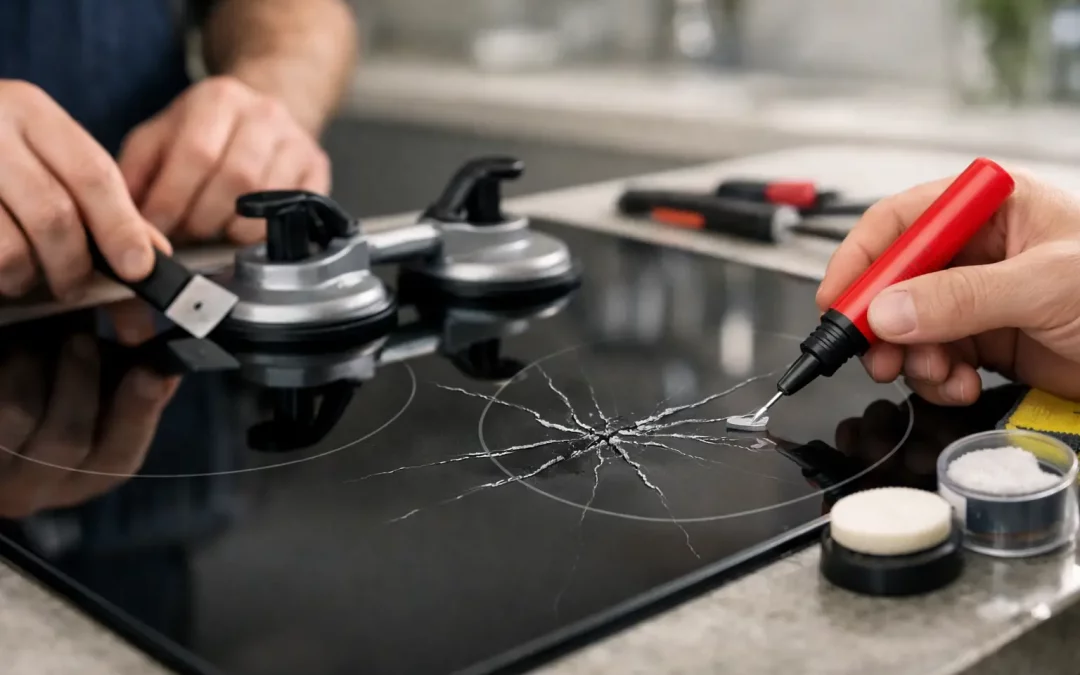
A glass cooktop can look like a single, simple sheet of black ceramic, but there is a lot happening beneath it. When an element stops heating, a touch control flashes an error, or the surface develops a crack, glass cooktop repair starts with identifying whether the problem is cosmetic, electrical, or a safety concern. That distinction matters. Some faults can be repaired in your home, while a cracked cooking surface often means the appliance should stay off until a technician assesses it.
For homeowners in Halifax Regional Municipality and nearby Nova Scotia communities, the goal is usually straightforward: get the kitchen working again without spending money on a repair that will not last. A proper diagnosis gives you a clear answer on the cause, the likely repair, and whether replacement makes better financial sense.
When a Glass Cooktop Is Unsafe to Use
A crack is not just a mark on the surface. The ceramic glass on an electric or induction cooktop is designed to handle heat, but it also protects the electrical components below. Once it is cracked, spills can pass through the surface and reach live wiring, controls, or heating elements.
Turn the cooktop off at the breaker and avoid using it if you notice a crack, chip near an element, a section that is lifting, or damage that runs from one edge to another. Do not cover the crack with tape, epoxy, or a cooktop mat and continue cooking. Those temporary fixes cannot restore the surface’s heat resistance or electrical protection.
A small scratch is different from a crack. Light surface scratching is common and may not affect operation. If your fingernail catches in the damage, the line is spreading, or you can see a visible break in the glass, treat it as a crack and arrange an assessment.
Common Glass Cooktop Problems and What They Mean
Not every cooktop failure requires a new glass surface. Many service calls involve components underneath the glass, including radiant elements, infinite switches, electronic control boards, temperature sensors, wiring, and cooling fans.
A Burner Will Not Heat
If one cooking zone stays cold while the others work, the cause may be a failed element, a loose or heat-damaged connection, or a control fault. On a radiant cooktop, you may see the element attempt to glow, cycle unpredictably, or remain completely cold. A technician can test the element and related wiring rather than replacing parts based on a guess.
If every burner is dead, the issue may be the power supply, breaker, terminal block, or main control. Most cooktops use a 240-volt circuit, so this is not a safe place for trial-and-error repairs. A breaker can sometimes trip without looking fully out of position, but repeated tripping needs professional attention.
A Burner Gets Too Hot or Will Not Turn Off
An element that stays on high, even when set to low or off, can damage cookware and create a burn risk. On older radiant units, a faulty infinite switch is often responsible. On models with electronic controls, the problem may involve a relay or control board. Switch the appliance off at the breaker and have it checked promptly.
Touch Controls Do Not Respond
Moisture, food residue, a child lock setting, or a control-panel fault can all make touch controls appear unresponsive. Start by cleaning and drying the control area with the power off. Check the owner’s manual for lock controls and error-code instructions specific to your model.
If the display keeps beeping, shows an error code after the surface is dry, or turns itself off during cooking, the cooktop may need diagnostic testing. Error codes are useful clues, but they do not always identify the failed part by themselves.
Induction Cooktop Will Not Detect a Pan
Induction cooktops heat magnetic cookware rather than the glass directly. A pan that is too small, warped, or non-magnetic may not be recognized. Test with a flat pot that a magnet sticks to and place it in the centre of the cooking zone.
When suitable cookware still will not work, the issue could be a pan sensor, induction module, power board, or cooling system. Induction repairs can be more specialized than conventional radiant cooktop repairs, so accurate model information helps the technician arrive prepared.
What You Can Safely Check Before Booking Service
A few simple checks can help rule out an avoidable issue, provided there is no crack, burning smell, sparking, or visible damage. Let the surface cool completely, then clean it with a product made for ceramic cooktops and a non-abrasive cloth. Built-up residue can interfere with touch controls and make the surface look more damaged than it is.
Confirm that the appliance has power and that the breaker has not tripped. If you reset a breaker, do it once. If it trips again, leave it off. Repeated resets can worsen an electrical fault.
For an induction unit, try a compatible pan. For a touch-control model, make sure the panel is dry and the lock function is off. Beyond those checks, it is best not to remove the cooktop from the counter or open its base. The glass can break under uneven pressure, and the electrical connections require safe testing equipment.
When Glass Cooktop Repair Makes Sense
Repair is often the sensible option when the glass is intact and the cooktop has a single failed component. Replacing an element, switch, sensor, wiring connection, or fan can extend the life of a quality appliance at a more manageable cost than replacing the full unit.
Replacing the glass can also be possible, depending on the model and the availability of the surface assembly. The trade-off is cost. On some older models, the glass and labour may approach the price of a new cooktop. In that case, age, overall condition, features, and installation requirements all matter. A newer premium induction cooktop may justify a substantial repair, while a basic unit near the end of its expected service life may not.
A trustworthy technician should explain the findings in plain language before work begins. Ask what part has failed, whether other components show heat damage, how long the repair is expected to last, and whether the replacement part is covered by warranty. Those answers make the repair-or-replace decision much easier.
Why Professional Diagnosis Protects Your Kitchen
Cooktops are built into countertops, connected to high-voltage power, and often secured with brackets or adhesive seals. Removing one incorrectly can chip a stone counter, damage cabinetry, or create a wiring hazard. There is also a practical reason to call for help: the symptom is not always the fault.
For example, a burner that will not heat may look like a failed element but actually have a damaged harness. A display problem may be caused by moisture, a cooling fan issue, or a failing board. Replacing the wrong part is an expensive way to delay the real repair.
Instant Appliance Repair provides in-home diagnosis and repair for electric and induction cooktops across Halifax, Bedford, Dartmouth, Sackville, Timberlea, Fall River, and surrounding communities. Customers receive clear repair advice, a free service call with every completed repair, and a 90-day parts-and-labour warranty on completed work.
Preventing Future Cooktop Damage
Ceramic glass is durable, but it does not respond well to sudden impacts or heavy cookware dropped from even a short distance. Lift pots instead of sliding rough-bottomed pans across the surface. Clean sugary spills as soon as the cooktop is safe to touch, since melted sugar can bond to the glass and leave permanent marks.
Use a cooktop scraper designed for glass surfaces for burnt-on residue, holding it at a shallow angle. Avoid abrasive powders, steel wool, and harsh cleaners that can scratch the surface or leave residue behind. Keep the underside and ventilation areas clear as well, particularly on induction units that rely on cooling fans.
A cooktop should feel predictable: the controls respond, the selected zone heats properly, and the surface remains intact. If yours does not, turning it off early and arranging a proper assessment can protect both your kitchen and your next meal.